
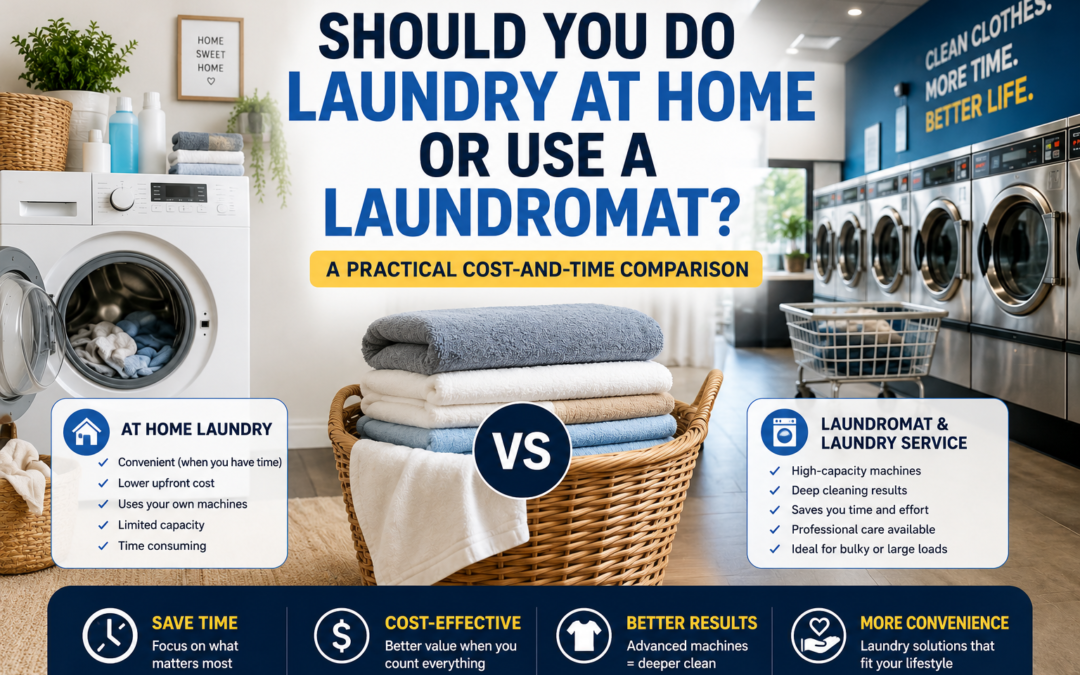
Laundry looks simple from the outside: put clothes in a washer, move them to the dryer, fold them, and put them away.
But anyone who regularly handles several loads a week knows that laundry is not one task. It is a chain of tasks that consumes time, equipment, water, electricity, detergent, storage space, attention, and often an entire portion of the weekend.
That raises a practical question for households, apartment residents, busy professionals, parents, and anyone dealing with large volumes of clothing:
Is doing laundry at home actually the most convenient or cost-effective option—or does using a laundromat or professional laundry service make more sense?
There is no universal answer. For a person with a modern washer and dryer, a small weekly load, and plenty of free time, home laundry may be perfectly reasonable. For someone with several loads waiting, limited washer capacity, bulky bedding, unreliable appliances, or a schedule that leaves little time for household chores, a laundromat can be the more practical solution.
And there is another option that changes the equation completely: wash and fold laundry service.
Instead of comparing only the price of a washer cycle with the price of a laundromat cycle, a better comparison considers the full cost of laundry—including time, equipment, utilities, capacity, maintenance, convenience, and the opportunity to spend that time elsewhere.
This guide breaks down the decision in practical terms so you can determine which approach makes the most sense for your household.
The Real Cost of Laundry Is More Than the Price of a Wash Cycle
When people compare doing laundry at home with using a laundromat, they often make the same mistake: they compare only the obvious out-of-pocket expense.
For example:
-
Home laundry appears to cost only detergent, water, and electricity.
-
Laundromat laundry has an obvious machine-use cost.
-
Wash and fold has a higher visible service price.
At first glance, home laundry therefore appears cheaper.
But that comparison leaves out several important variables.
A more complete laundry-cost model looks something like this:
Total laundry cost = equipment + utilities + supplies + maintenance + time + capacity constraints + inconvenience.
The last two factors are particularly important.
Imagine spending two hours every weekend sorting clothes, loading machines, transferring loads, waiting for cycles, folding everything, and putting it away. If your household produces several loads every week, the annual time commitment can become substantial.
A laundromat changes the equipment and capacity equation. A wash and fold service changes the labor equation.
That is why the best question isn’t simply:
“Which option has the lowest price per load?”
A better question is:
“Which laundry method gives me the best combination of cost, capacity, time, convenience, and reliability?”
That is a much more useful way to make the decision.
Home Laundry: When It Makes Sense
Doing laundry at home can be an excellent choice under the right circumstances.
If you have:
-
A reliable washer
-
A reliable dryer
-
Adequate laundry space
-
Reasonable household laundry volume
-
Enough time to manage multiple cycles
-
No problem handling folding and sorting
-
No large or unusual laundry loads
then home laundry can be convenient.
You also have complete control over when a load is started, what detergent is used, what temperature is selected, and how individual garments are handled.
For households with a manageable laundry volume, that control can be valuable.
However, the economics change when the laundry workload becomes larger than your home’s equipment or your available time.
The Hidden Equipment Cost
A residential washer and dryer are not free simply because you already own them.
The purchase price represents only the beginning of the ownership cost.
Over time, homeowners may encounter:
-
Appliance repairs
-
Replacement parts
-
Dryer vent maintenance
-
Washer maintenance
-
Installation expenses
-
Water consumption
-
Electricity or gas consumption
-
Detergent and laundry products
-
Premature appliance replacement
The useful life of laundry equipment also varies based on the appliance, usage patterns, maintenance, and load frequency.
A household doing one or two loads per week places a very different demand on its equipment than a large family doing laundry nearly every day.
This is where the concept of cost per load becomes useful.
Suppose a household spends $1,500 combined on a washer and dryer and keeps the equipment for eight years. That does not mean the appliances cost nothing after purchase. Their cost is being distributed across every load washed and dried during that period.
The same principle applies to utilities and maintenance.
What About Water and Energy Costs?
Water and energy are genuine costs of home laundry, although modern appliances have become considerably more efficient.
The U.S. Environmental Protection Agency’s ENERGY STAR program notes that certified clothes washers use substantially less energy and water than conventional models. ENERGY STAR reports that certified washers use about 20% less energy and 30% less water than standard washers.
That means an efficient home washer can significantly reduce operating costs compared with older equipment.
But efficiency does not eliminate the cost of doing laundry.
The number of loads matters.
The size of each load matters.
Water temperature matters.
Drying habits matter.
And household laundry volume matters.
ENERGY STAR also recommends running full washer loads when practical because washers use relatively similar amounts of energy regardless of load size.
This creates an important practical consideration:
If your household routinely generates small loads because your laundry schedule is fragmented, you may be using your equipment less efficiently than you think.
On the other hand, overloading a residential machine simply to avoid another load is not a smart solution either.
The goal is not to fit as much laundry as physically possible into a washer.
The goal is to use the appropriate capacity for the load.
The Capacity Problem: Where Home Laundry Starts to Break Down
Capacity is one of the biggest reasons people eventually start using a laundromat.
Consider a household that needs to wash:
-
Several baskets of clothing
-
Multiple sets of towels
-
Bed sheets
-
Comforters
-
Blankets
-
Large household items
A residential washer has a defined drum capacity.
If the load is too large, the answer isn’t necessarily to stuff everything inside and hope for the best.
Laundry needs room to move.
Water and detergent need to circulate.
Clothing needs mechanical action.
During drying, items need sufficient space to tumble and allow warm air to circulate.
This becomes particularly important with bulky items.
A comforter, for example, may occupy a large portion of a residential washer’s available space even when its actual weight isn’t especially high.
That is why a large-capacity laundromat washer can be more practical for certain items than repeatedly dividing them into several smaller residential loads.
ENERGY STAR specifically notes that greater washer capacity can reduce the number of loads required, particularly for larger items such as comforters.
The Laundromat Advantage: Capacity Changes the Equation
A laundromat is not simply a place where you pay to use someone else’s washing machine.
The fundamental advantage is access to commercial-scale laundry capacity without having to own commercial-scale equipment.
This matters when your home equipment cannot comfortably handle the workload.
At Smiley Laundromat in Stone Mountain, customers have access to multiple washer sizes, including machines designed for different laundry volumes.
That means a customer can select equipment according to the actual load instead of forcing every laundry situation into the capacity of one residential washer.
For someone washing everyday clothes, a smaller machine may be appropriate.
For a family load, a larger machine may make more sense.
For bulky bedding or significant quantities of towels, a high-capacity machine can reduce the number of separate cycles required.
The important point is not simply “bigger is better.”
It is:
The right machine for the right load can make laundry more efficient.
When a Laundromat Can Be More Practical Than Home Laundry
There are several situations where a laundromat becomes particularly attractive.
1. Your Washer Is Too Small
If you frequently need to divide laundry into several loads simply because your home washer cannot accommodate it, a laundromat may save substantial time.
2. Your Dryer Cannot Keep Up
A household may have a perfectly adequate washer but an inefficient or undersized dryer.
That creates a bottleneck.
You wash several loads, but then spend hours waiting for everything to dry.
3. You Have Bulky Items
Comforters, blankets, large bedding sets, rugs, and other oversized washable items can be difficult to process at home.
Large-capacity machines are specifically useful in these situations.
4. Your Appliances Are Being Repaired
A broken washer or dryer can turn an ordinary household chore into an immediate logistical problem.
A laundromat provides a temporary or ongoing alternative without requiring you to purchase replacement equipment immediately.
5. You Have a Large Laundry Backlog
Sometimes the problem isn’t your normal weekly laundry.
It’s the laundry accumulated after:
-
Travel
-
Holidays
-
Illness
-
A busy work period
-
Moving
-
Hosting guests
-
Family events
-
Appliance downtime
In those situations, access to multiple machine capacities can help you catch up more efficiently.
But What About the Time Factor?
This is where the comparison becomes much more interesting.
A laundry cycle may take roughly an hour or more, depending on the machine and settings.
But the machine’s cycle time isn’t necessarily your total laundry time.
You also have to account for:
-
Sorting
-
Loading
-
Starting the machine
-
Waiting
-
Transferring clothes
-
Starting the dryer
-
Checking the dryer
-
Removing clothes
-
Sorting again
-
Folding
-
Putting clothes away
Some of these activities require active attention.
Others require you to remain available or return to the laundry area.
This is known as opportunity cost.
Your time has value even when you aren’t paying yourself an hourly wage.
If you could spend that time working, resting, exercising, spending time with your children, running errands, or simply relaxing, then the time involved in laundry has a real practical cost.
That doesn’t mean everyone should outsource laundry.
It means the decision should reflect how much you value your time.
A Simple Way to Calculate Your Laundry Time
Try this exercise.
For one typical week, record:
-
Number of loads
-
Average wash time
-
Average dry time
-
Sorting time
-
Folding time
-
Time spent transferring loads
-
Time spent traveling to and from a laundry facility, if applicable
Then calculate the total.
For example, imagine a household completes six loads per week.
If each load requires only 15 minutes of active handling between sorting, loading, transferring, unloading, and folding, that’s already:
6 × 15 minutes = 90 minutes per week.
That’s 1.5 hours.
Over a year:
1.5 × 52 = 78 hours.
And that excludes passive waiting, travel, appliance maintenance, and the mental effort involved in keeping track of the laundry.
If folding and sorting take longer, the number rises quickly.
This is why professional laundry service can be valuable even when the customer could technically do the laundry themselves.
The Case for Wash and Fold Laundry Service
Self-service laundry solves the equipment and capacity problem.
Wash and fold solves something bigger:
the labor problem.
Instead of spending your own time washing, drying, folding, and organizing laundry, you pay a professional service to handle those tasks.
Smiley Laundromat’s wash and fold service is designed for customers who want the laundry handled rather than simply wanting access to a washing machine.
Customers can bring laundry in, provide special instructions, and have the items washed, dried, folded, and prepared for pickup.
Smiley also provides stain pre-treatment when customers identify an item that needs additional attention before washing.
That creates a different value proposition from self-service.
You aren’t merely paying for machine time.
You’re paying to remove a recurring household task from your schedule.
Who Benefits Most From Wash and Fold?
Professional wash and fold is particularly practical for people whose biggest laundry problem is time rather than equipment.
Busy Professionals
If work consumes most of your weekdays and weekends are already full, laundry can become another recurring obligation competing for limited free time.
Families
The larger the household, the more frequently laundry tends to appear.
Parents may find that washing and folding several loads every week becomes an ongoing background task.
Seniors
For some customers, transporting heavy laundry baskets, moving bulky loads, and standing through repetitive laundry tasks may be inconvenient.
Professional service can simplify the process.
Apartment Residents
Not every apartment has convenient in-unit laundry.
Even when a shared laundry room is available, customers may have to wait for machines, carry laundry between floors, or coordinate their schedule around equipment availability.
People During Busy Periods
You don’t have to use wash and fold every week.
It can also make sense temporarily.
For example, you might use professional laundry service during:
-
Moving week
-
A major work deadline
-
The arrival of a new baby
-
Home renovations
-
Holiday periods
-
Travel-heavy weeks
-
Family events
-
Appliance repairs
The service becomes a pressure-release valve when life gets unusually busy.
Self-Service vs. Wash and Fold: Which Should You Choose?
The best choice depends on the problem you are trying to solve.
| Your Situation | More Practical Option |
|---|---|
| You enjoy doing your own laundry | Self-service or home laundry |
| Your home washer is too small | Laundromat |
| You have bulky bedding | Large-capacity laundromat machine |
| Your washer is broken | Laundromat |
| Your dryer cannot keep up | Laundromat |
| You have several loads to catch up on | Laundromat |
| You have plenty of time | Self-service can make sense |
| You have very little free time | Wash and fold |
| You dislike folding | Wash and fold |
| You have recurring family laundry | Wash and fold may be worthwhile |
| You run a business with recurring laundry | Commercial laundry service |
| You need maximum convenience | Wash and fold or pickup/delivery |
The key is to match the service to the problem.
What About Cost? Look Beyond the Sticker Price
This is where laundry comparisons become misleading.
Suppose doing laundry at home costs less in direct expenses than paying for a professional laundry service.
That does not automatically mean home laundry is the cheaper choice.
Consider a household spending two hours each weekend on laundry.
If those two hours are valuable to the customer, then the customer is effectively exchanging time for savings.
The right comparison is therefore:
Direct laundry expense + value of time + equipment costs + inconvenience
versus
Professional service cost + time saved + convenience gained
There is no universal dollar figure for the value of someone’s free time.
A college student may value two hours differently from a business owner.
A parent may value a free Saturday differently from someone who enjoys doing laundry.
A household with a broken dryer may value reliability differently from someone with brand-new appliances.
This is why a simple “laundromat vs. home laundry cost” calculator can be misleading if it ignores time.
The Economics of Large Loads
Large loads deserve their own consideration.
Imagine you have a king-size comforter, several blankets, and a large collection of towels.
At home, you may have to process them separately.
That means:
-
More wash cycles
-
More dryer cycles
-
More transfers
-
More waiting
-
More folding
-
More opportunities to forget a load
A high-capacity laundromat machine can consolidate appropriate items into fewer cycles.
The value isn’t necessarily that each individual cycle is cheaper.
The value is that the entire laundry job may require fewer cycles and less active management.
This is an important distinction.
Efficiency isn’t always about paying less for one cycle. It can be about completing the entire job with fewer steps.
Why Dryer Capacity Matters Too
People often focus on washers and forget that drying is another potential bottleneck.
After washing, clothes contain significant moisture.
The dryer must remove that moisture efficiently while allowing air to circulate through the load.
If the dryer is overloaded, drying can take longer and become less effective.
ENERGY STAR recommends maintaining good airflow and cleaning lint filters regularly because restricted airflow can affect dryer performance and safety.
This is another reason capacity matters.
A large quantity of laundry may be easier to process using appropriately sized commercial laundry equipment than by repeatedly filling a small residential dryer.
What About Laundry Quality?
Cost and convenience are not the only factors.
Laundry quality matters too.
The objective is not simply to make clothes wet, spin them, and dry them.
Good laundry practice involves:
-
Appropriate load size
-
Correct water temperature
-
Suitable detergent
-
Proper sorting
-
Appropriate drying
-
Attention to stains
-
Care with delicate materials
-
Avoiding excessive heat
-
Avoiding overloading
Modern washing machines are engineered around specific load capacities and wash mechanics.
ENERGY STAR notes that newer efficient washers use advanced wash systems and can be gentler on clothing than traditional agitator machines.
The practical lesson is straightforward:
Don’t judge laundry equipment solely by drum size or cycle speed.
The right machine, the right load size, and the right process all matter.
When You Should Not Use Wash and Fold
A trustworthy laundry guide should also explain when professional service may not be the right choice.
Wash and fold isn’t ideal for every garment.
Smiley Laundromat notes that garments with glued-on decorations or excessive beading are not recommended for its wash and fold service.
Customers should always check care labels and communicate special requirements before sending garments for professional laundering.
Some items may require:
-
Hand washing
-
Air drying
-
Specialized cleaning
-
Delicate handling
-
Manufacturer-specific care
Professional laundry service is designed to simplify appropriate everyday laundry—not replace every specialized garment-care method.
Knowing what not to put into a standard wash-and-fold order is just as important as knowing what belongs in it.
How to Make Home Laundry More Efficient
Even if you decide that home laundry is best for you, there are ways to improve the process.
Run Full Loads When Appropriate
ENERGY STAR recommends running full loads when practical because washers use roughly similar amounts of energy regardless of load size.
Don’t confuse “full” with “overloaded,” however.
Clothing needs room to move.
Use Cold Water When Appropriate
ENERGY STAR notes that water heating accounts for a significant share of washer energy use and recommends cold-water washing for many ordinary loads.
Always consider the fabric, stain type, detergent, and care instructions.
Don’t Overdry
Excessive dryer heat can contribute to unnecessary wear.
Use an appropriate drying cycle and remove clothing promptly when possible.
Clean the Lint Filter
A clean lint filter supports airflow and dryer efficiency and is an important safety practice.
Consolidate Laundry Tasks
Instead of constantly doing one small load after another, develop a predictable schedule based on your household’s actual laundry volume.
How to Make Laundromat Laundry More Efficient
If you decide to use a laundromat, planning can make a major difference.
Sort Before You Leave Home
Separate clothes by color, fabric, or wash requirements before arriving.
That reduces time spent sorting at the laundromat.
Estimate Your Load Size
Don’t automatically choose the smallest machine.
The appropriate machine should accommodate the load without overfilling it.
Bring Everything You Need
Have detergent, laundry bags, and any other necessary supplies ready.
Use the Waiting Time Productively
If the facility provides amenities such as Wi-Fi, laundry time can become an opportunity to catch up on work, messages, or entertainment rather than simply waiting.
Consider Wash and Fold When the Problem Is Time
If you repeatedly find yourself thinking, “I don’t have time to do this,” the issue may no longer be machine access.
It may be time to outsource the task.
How Smiley Laundromat Fits Into the Decision
Smiley Laundromat in Stone Mountain provides several ways to approach laundry depending on what the customer actually needs.
For customers who prefer to handle their own laundry, self-service machines provide access to different washer and dryer capacities.
For customers who want to remove the work from their schedule, wash and fold provides a more hands-off alternative.
For customers looking for additional convenience, pickup and delivery services can further reduce the amount of time spent managing laundry.
The result is not one single laundry solution.
It is a range of options.
That distinction matters because customers do not all have the same problem.
One person may need a large-capacity washer.
Another may need to catch up on six loads.
Another may have a broken home appliance.
Another may simply have a demanding work schedule.
Another may operate an Airbnb or local business with recurring laundry.
A useful laundry provider should help customers choose the option that fits the situation rather than assuming every customer needs the same service.
What Makes Wash and Fold Different From Self-Service?
Self-service gives you the equipment.
Wash and fold gives you the result without requiring you to perform every step yourself.
That’s the central difference.
With self-service, you typically remain responsible for:
-
Sorting
-
Loading
-
Choosing cycles
-
Transferring laundry
-
Drying
-
Folding
-
Packing
With wash and fold, the provider takes responsibility for the core processing.
This is why wash and fold is best understood as a time-saving service, not simply another way to wash clothes.
Smiley Laundromat has also published a detailed explanation of how its service is designed around speed and convenience in Why Smiley Laundry’s Wash & Fold Service Stands Out for Speed and Convenience, which provides additional insight into the customer experience.
Why Turnaround Time Matters
When people outsource laundry, they naturally want to know one thing:
When will I get it back?
Turnaround time affects how useful a laundry service is within a customer’s routine.
A service that takes too long may not solve the customer’s immediate problem.
Smiley Laundromat states that its wash and fold orders are completed within 48 hours.
For customers planning around work schedules, family responsibilities, or recurring laundry needs, having a defined turnaround expectation makes it easier to plan.
You can also read How Smiley Laundry’s 48-Hour Wash & Fold Service Helps Customers Stay Ahead for a deeper look at how predictable turnaround can help customers avoid letting laundry pile up.
The “Cheapest” Laundry Option Isn’t Always the Cheapest
This may be the most important conclusion in the entire comparison.
If your only objective is to minimize the money leaving your wallet today, home laundry may frequently appear to win.
But if your objective is to optimize:
-
Time
-
Convenience
-
Capacity
-
Reliability
-
Household workload
-
Appliance dependence
-
Laundry turnaround
-
Overall routine
then the answer becomes more nuanced.
A laundromat may be worth it because it handles a large load efficiently.
Wash and fold may be worth it because it removes hours of labor from your week.
Pickup and delivery may be worth it because it removes both the laundry work and the trip.
Home laundry may be worth it because you enjoy doing it and already have suitable equipment.
The best laundry solution is the one that solves your actual problem.
A Practical Decision Framework
Before deciding what to do with your next laundry pile, ask yourself seven questions.
Question 1: How much laundry do I have?
One small load is very different from eight large loads.
Question 2: Can my home equipment handle it comfortably?
If the answer is no, a laundromat may immediately become more practical.
Question 3: Do I have bulky items?
Comforters, blankets, bedding, and other oversized items may benefit from large-capacity machines.
Question 4: How much time do I have?
If your schedule is packed, wash and fold deserves serious consideration.
Question 5: Do I actually want to do the laundry?
This sounds obvious, but it’s an important question.
There is a difference between being able to do something and wanting to spend your time doing it.
Question 6: Is this a temporary problem or an ongoing one?
A single busy week may call for occasional wash and fold.
A permanent schedule problem may justify making professional laundry service part of your routine.
Question 7: What is my time worth?
This is the question most laundry comparisons ignore.
Once you include your time, the economics can look very different.
A Better Way to Think About Laundry in 2026
Laundry is changing because people’s relationship with time is changing.
Modern households increasingly pay for convenience when doing so removes repetitive tasks from their schedules.
The same principle applies to meal delivery, grocery delivery, home cleaning, and other household services.
Laundry fits naturally into that broader shift.
A professional laundry provider is no longer simply a place to wash clothes.
It can provide:
-
Equipment access
-
Large-load capacity
-
Wash and fold
-
Pickup and delivery
-
Commercial laundry support
-
Time savings
-
Predictable turnaround
-
Convenience
That creates a spectrum of choices.
At one end, you do everything at home.
In the middle, you use a laundromat’s equipment but manage the process yourself.
Further along, you drop off your laundry and let professionals handle the washing and folding.
At the highest-convenience end, pickup and delivery can reduce your involvement even further.
The right point on that spectrum depends on your household.
Home Laundry or Laundromat?
So, should you do laundry at home or use a laundromat?
If you have manageable laundry volume, reliable appliances, adequate capacity, and plenty of time, home laundry can make sense.
But if your laundry volume is high, your machines are too small, your dryer cannot keep up, you regularly wash bulky items, or you need to process a large backlog, a laundromat can be a more practical solution.
And if your biggest problem isn’t equipment but time, professional wash and fold may be the better choice.
That is ultimately the most useful way to approach the decision.
Don’t ask only:
“Which costs less per load?”
Ask:
“Which option gives me the best overall value for my money, time, capacity, and lifestyle?”
For some households, that answer will be home laundry.
For others, it will be self-service laundry at a modern laundromat.
And for increasingly busy households, professionals, families, and businesses, the answer may be professional laundry service.
Smiley Laundromat gives customers in Stone Mountain and North Atlanta the flexibility to choose the approach that fits their needs—from self-service washing and drying to wash and fold and convenient laundry pickup and delivery.
Because the goal isn’t simply to get clothes clean.
The goal is to make laundry fit your life instead of making your life revolve around laundry.
Recent Comments