
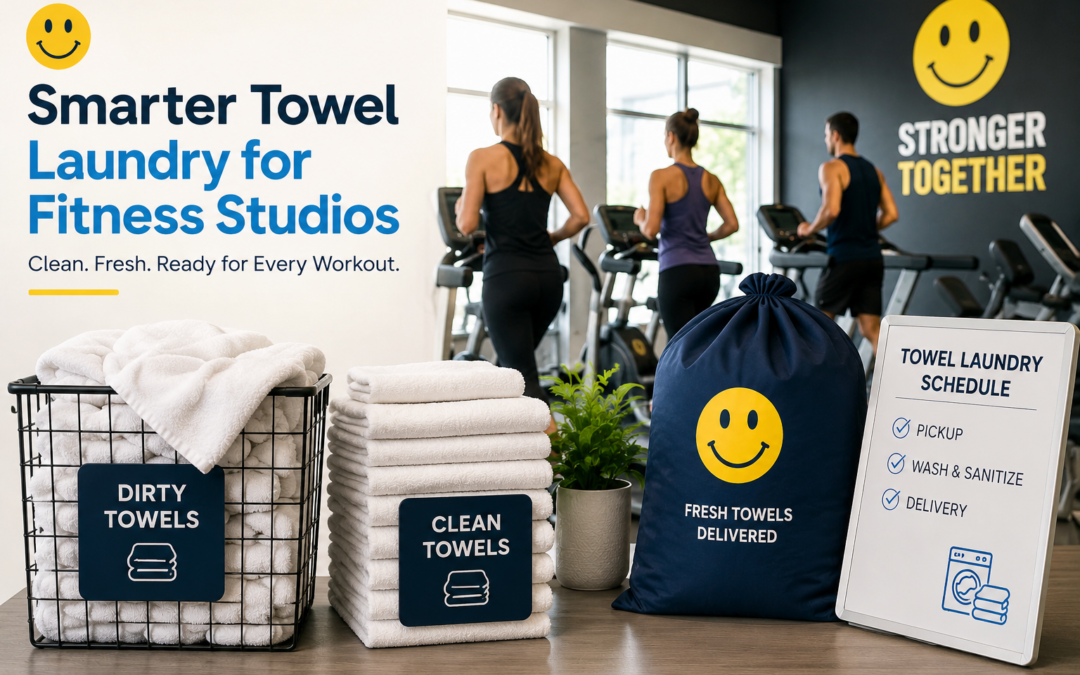
Walk into a busy fitness studio at almost any point during the day and you will see the same pattern.
Fresh towels disappear from the supply area.
Members use them during workouts.
Staff collect the used towels.
More towels enter the laundry area.
A washer starts running.
Then another.
The dryer fills up.
A basket of clean towels needs to be folded.
Another basket of used towels appears.
And before the previous laundry cycle is finished, the next one has already started.
For fitness studios, gyms, yoga facilities, Pilates studios, personal training centers, cycling studios, martial arts facilities, spas, and wellness businesses, towel laundry is not an occasional chore. It is a recurring operational process.
The larger the facility and the more members it serves, the more important that process becomes.
A studio may start with a small stack of towels and handle everything internally without difficulty. But as membership grows, class schedules become busier, and towel usage increases, laundry can quietly become a significant drain on employee time, facility space, equipment capacity, utilities, and management attention.
That is why many fitness businesses eventually ask an important operational question:
Should we continue handling towel laundry in-house, or would a professional laundry service be more efficient?
The answer depends on volume, labor, equipment, towel turnover, storage capacity, operating hours, and the value of employee time.
But for many growing fitness businesses, professional commercial laundry service can provide a much more scalable solution.
The goal is not simply to get towels clean.
The goal is to maintain a reliable supply of clean towels without allowing laundry to interfere with the business’s primary purpose: serving members and running profitable classes.
This guide explains how fitness studios can build a more efficient towel-laundry system, why commercial laundry service can make financial and operational sense, how to calculate the true cost of in-house towel processing, how to manage towel inventory, and what to look for when choosing a professional laundry provider.
Why Towel Laundry Is Different From Ordinary Laundry
A fitness studio’s laundry profile is different from a typical household.
Household laundry is usually distributed across several categories:
-
Clothing
-
Bedding
-
Towels
-
Underwear
-
Children’s clothing
-
Seasonal items
Fitness studios can have a much narrower but much more repetitive laundry stream.
The same textile category may be processed over and over:
Workout towel -> Used towel -> Laundry -> Clean towel -> Member -> Used towel
That creates a continuous turnover loop.
The business therefore needs to manage not just cleaning, but also inventory availability.
A towel sitting in a laundry basket is not available to a member.
A towel sitting wet inside a washer is not available.
A clean towel waiting to be folded is technically clean but may not be ready for distribution.
A properly folded and stored towel is operational inventory.
This distinction is critical.
The Real Objective Is Towel Availability
A fitness studio should not measure laundry efficiency solely by the number of loads washed.
A better metric is:
Clean towels available when members and staff need them.
That changes how you think about laundry.
Suppose a studio processes 100 towels every day.
If the laundry system keeps 150 clean towels available throughout the operating day, the system is functioning well.
If the same studio regularly runs out of clean towels at 6:00 PM, it has an inventory and workflow problem even if all 100 towels eventually get washed.
The objective is not merely cleaning.
It is maintaining service availability.
Why Fitness Studios Can Generate Surprisingly High Laundry Volumes
Towel demand depends on the type of facility.
A traditional gym may provide towels for:
-
Workout equipment
-
Showers
-
Locker rooms
-
General member use
A hot yoga studio may experience much higher towel usage because members can generate significant perspiration during classes.
A cycling studio may have high towel turnover during every class.
A Pilates studio may use towels for equipment, cleaning, and member comfort.
A spa or wellness facility may have towels as a central part of the customer experience.
Personal training facilities may use fewer towels overall but still require consistent availability.
This is why towel consumption should be measured rather than guessed.
Calculate Towels Used Per Class
One of the simplest ways to understand your laundry workload is to measure towel usage per class.
For example, imagine a studio with:
-
20 classes per week
-
18 average attendees
-
1 towel per attendee
That creates:
20 × 18 = 360 towels per week
Now add:
-
Staff towels
-
Cleaning towels
-
Shower towels
-
Replacement towels
-
Towels used during special events
The actual volume can be substantially higher.
Now consider a larger facility.
If 100 towels are used every operating day, the annual volume can reach tens of thousands of towels.
At that scale, laundry stops being a minor administrative task.
It becomes a real operating process.
The Laundry Backlog Problem
Laundry backlog is particularly dangerous in fitness facilities because towel usage is continuous.
A household can decide to postpone laundry for a day.
A fitness studio cannot necessarily do that.
Members arrive according to a schedule.
Classes start at fixed times.
Towels are needed throughout the day.
If the laundry system falls behind, the problem compounds.
For example:
Monday: 100 towels used
Tuesday: 100 towels used
Wednesday: 100 towels used
If the studio can only process 150 towels per day, the backlog continues growing.
Eventually, management may be forced to:
-
Buy emergency towels
-
Run machines overnight
-
Assign more employees to laundry
-
Reduce towel availability
-
Ask staff to handle laundry during busy periods
-
Purchase additional equipment
This is why laundry capacity should be designed around peak usage, not just average usage.
The Importance of Peak Laundry Volume
A studio might average 80 towels per day.
But what happens on Saturday?
Maybe attendance doubles.
Maybe there are additional classes.
Maybe a special workshop brings in more members.
Maybe the studio hosts an event.
Laundry planning should account for these peaks.
If your laundry infrastructure is designed only for average volume, the system can become overloaded during busy periods.
A professional laundry provider may provide additional processing capacity without requiring the fitness studio to purchase enough equipment to handle its highest possible laundry volume.
In-House Laundry vs. Professional Laundry Service
There are two primary approaches.
In-House Laundry
The studio owns or operates the laundry equipment.
Employees collect, sort, wash, dry, fold, and store the towels.
The business maintains control over the entire process.
Outsourced Laundry Service
The studio sends towels to a professional laundry provider.
Depending on the service, laundry may be picked up, washed, dried, folded, packaged, and returned.
This shifts much of the labor and equipment burden away from the studio.
Neither model is automatically better.
The right choice depends on economics and operations.
The Hidden Cost of In-House Towel Laundry
The biggest mistake fitness studios make is treating laundry as a free employee task.
It is not free.
If a front desk employee spends an hour processing towels, that hour has a cost.
If a manager spends 30 minutes folding towels, that time has a cost.
If a trainer transports towels to a laundromat, that time has a cost.
If a machine breaks, that has a cost.
If the studio needs to buy a larger washer, that has a cost.
The full calculation should include:
-
Labor
-
Payroll burden
-
Utilities
-
Detergent
-
Equipment
-
Maintenance
-
Repairs
-
Replacement
-
Laundry space
-
Storage
-
Transportation
-
Rewashing
-
Lost productivity
Once these costs are included, outsourcing can become much more competitive.
Calculate the Labor Cost First
Labor is usually one of the most important variables.
Suppose a studio spends 15 hours per week handling towels.
That equals:
15 × 52 = 780 hours per year
If the fully loaded labor cost is $22 per hour:
780 × $22 = $17,160 per year
That is more than $17,000 of annual labor allocated to laundry.
And that is before accounting for:
-
Water
-
Electricity
-
Gas
-
Detergent
-
Equipment
-
Repairs
-
Transportation
A professional laundry quote that initially looks expensive may actually be financially attractive once the internal labor cost is properly calculated.
Employee Time Should Be Used Where It Creates the Most Value
A fitness studio employs people to create and support member experiences.
Front desk employees can:
-
Check in members
-
Answer questions
-
Handle memberships
-
Schedule appointments
-
Support sales
-
Manage customer service
Trainers can:
-
Coach members
-
Conduct assessments
-
Lead sessions
-
Improve retention
-
Build relationships
Managers can:
-
Manage staff
-
Monitor operations
-
Improve marketing
-
Build partnerships
-
Review financial performance
Laundry is necessary.
But it may not be the highest-value use of those employees’ time.
Outsourcing can allow the business to redirect labor toward core activities.
The Opportunity Cost of Laundry
Opportunity cost is one of the most important concepts in this decision.
Suppose a trainer spends one hour per day on laundry.
That trainer is not training clients during that hour.
The business is not necessarily losing exactly one hour of revenue.
But it is losing the opportunity to use that labor productively.
Now multiply that across weeks and months.
Small inefficiencies become significant annual costs.
This is why businesses should evaluate laundry using labor utilization, not just direct expenses.
The Equipment Cost of In-House Laundry
In-house laundry requires equipment.
Depending on the studio’s volume, that may include:
-
Commercial washers
-
Commercial dryers
-
Laundry carts
-
Sorting bins
-
Folding tables
-
Shelving
-
Storage cabinets
-
Plumbing
-
Drainage
-
Ventilation
Equipment also has a lifecycle.
Machines eventually need:
-
Preventive maintenance
-
Replacement parts
-
Repairs
-
Replacement
A business must either budget for those expenses or accept the risk of unexpected downtime.
What Happens When a Washer Breaks?
This question deserves more attention than it usually gets.
If a home washer breaks, the household can wait a few days.
A fitness studio may not have that luxury.
If the studio depends on one commercial washer and it stops working, towel inventory can deteriorate quickly.
The business may have to:
-
Find a laundromat
-
Transport towels
-
Pay emergency service costs
-
Buy additional towels
-
Run longer shifts
-
Ask employees to work outside normal responsibilities
Professional laundry service shifts much of that equipment risk to the laundry provider.
The studio still needs a contingency plan, but it does not necessarily have to own the entire laundry infrastructure.
Space Is Also an Operating Cost
Fitness studios operate in expensive commercial spaces.
Every square foot matters.
A laundry area requires:
-
Machines
-
Utility connections
-
Storage
-
Sorting space
-
Folding space
-
Laundry carts
-
Finished towel storage
That space could potentially be used for:
-
Additional equipment
-
Member seating
-
Retail products
-
Staff space
-
Storage
-
Treatment areas
-
Expansion
If laundry consumes valuable square footage, the business should include that cost in its evaluation.
Water and Energy Costs Add Up
Laundry consumes water and energy.
A high-volume fitness studio may run washers and dryers every day.
Drying can be particularly energy-intensive.
The total utility cost depends on equipment efficiency, cycle settings, load sizes, local utility rates, and operating practices.
Modern equipment can improve efficiency, but high laundry volume still means high total resource consumption.
A professional laundry provider can potentially spread those infrastructure costs across a large volume of customers.
Why Economies of Scale Matter
A fitness studio may process hundreds or thousands of towels per week.
A commercial laundry provider may process many times that volume across multiple customers.
This creates economies of scale.
The provider can utilize:
-
Larger machines
-
Specialized equipment
-
Dedicated staff
-
Established workflows
-
High equipment utilization
-
Centralized supplies
-
Standardized processing
The studio does not need to duplicate all of that infrastructure.
This is one of the strongest economic arguments for commercial laundry service.
The Cleaning Science Behind Fitness Towels
Fitness towels are exposed to a distinctive combination of soils.
They can contain:
-
Sweat
-
Body oils
-
Skin cells
-
Deodorant
-
Cosmetic residue
-
Dirt
-
Cleaning chemicals
-
Moisture
That means effective laundering requires more than simply rinsing the towels.
Cleaning performance depends on the interaction between:
Water + chemistry + mechanical action + temperature + time + extraction + drying
Each factor plays a role.
Why Mechanical Action Matters
Washing machines do more than soak textiles.
Mechanical movement helps detach soils from fibers.
Towels require enough movement to clean effectively while avoiding unnecessary textile stress.
Commercial laundry equipment can be configured to handle high-volume textile processing.
The goal is not maximum agitation.
It is appropriate mechanical action for the textile and soil profile.
Detergent Chemistry for Towel Laundry
Towel laundry can contain substantial organic and oily soils.
Detergent chemistry helps suspend and remove these contaminants.
Surfactants help interact with oily soils.
Enzymes can target certain organic residues.
Builders can help improve detergent performance under certain water conditions.
However, using more detergent does not automatically produce cleaner towels.
Excess detergent can leave residues if the wash and rinse process is not properly balanced.
A professional laundry service should use a consistent process rather than relying on excessive detergent to compensate for inadequate cleaning.
Why Rinsing Matters
The wash process removes soil.
The rinse process removes suspended soil, detergent residues, and other contaminants.
Insufficient rinsing can leave residues behind.
For towels, this can affect:
-
Feel
-
Absorbency
-
Odor
-
Appearance
This is another reason professional processing can be beneficial for businesses that require consistent towel quality.
Drying Fitness Towels Correctly
Drying is a critical stage.
Towels need to be dried thoroughly before storage.
But high heat is not automatically better.
Excessive heat can affect textile fibers over time.
The goal is complete moisture removal using an appropriate drying process.
A commercial dryer can provide high-capacity drying that matches the volume of towels being processed.
Damp Towels Create Operational Problems
One of the biggest mistakes a fitness studio can make is allowing damp towels to sit in closed containers for extended periods.
Warmth and moisture can create an environment where unpleasant odors develop.
This can become especially problematic when towels are collected throughout the day and laundry is delayed until the following morning.
A strong laundry workflow should minimize the time between:
Used -> Collected -> Washed -> Dried -> Stored
That cycle should be predictable.
Laundry Storage Matters Too
Clean towels need appropriate storage.
They should be separated from used towels.
The studio should establish clear zones for:
-
Used towels
-
Towels awaiting processing
-
Clean towels
-
Clean towels ready for distribution
Mixing clean and used inventory creates unnecessary confusion.
Good storage also makes it easier for employees to identify when the clean towel inventory is getting low.
Build a Towel Par Level
A fitness studio should consider establishing a towel par level.
A par level is the target quantity of inventory needed to operate effectively.
For example, a studio might determine that it needs:
-
One day’s supply in use
-
One day’s supply in laundry
-
One day’s supply clean and ready
-
Additional emergency inventory
The exact number depends on the facility.
The principle is more important than the specific number.
You should have enough towels to keep the business operating while part of the inventory is being processed.
Why Three-Batch Thinking Can Help
A simple way to conceptualize towel inventory is:
Batch 1: In use
Batch 2: Being processed
Batch 3: Clean and ready
If your total inventory is too small, the system becomes fragile.
A delay in laundry immediately affects towel availability.
Increasing towel inventory can provide a buffer.
But there is a balance.
Buying hundreds of extra towels ties up capital and requires storage space.
The goal is not maximum inventory.
It is appropriate inventory.
Track Towel Turnover
A useful operational metric is towel turnover.
You can calculate:
Towel turnover rate = towels used per period / available towel inventory
Suppose a studio owns 500 towels and uses 250 per day.
That means a significant portion of the inventory is moving through the laundry system every day.
High turnover increases the importance of efficient processing.
If the laundry cycle becomes slower, the required inventory may increase.
Measure Laundry Pounds, Not Just Loads
For commercial laundry planning, weight can be more useful than the number of loads.
One “load” can mean very different things depending on the equipment.
A small residential washer and a large commercial washer do not represent equivalent processing capacity.
Businesses should therefore track:
-
Pounds per day
-
Pounds per week
-
Number of towels
-
Average towel weight
-
Peak laundry volume
-
Number of processing cycles
This information can make conversations with professional laundry providers much more accurate.
The Case for Wash and Fold for Fitness Studios
Wash and fold can be a strong option for smaller fitness businesses.
The studio collects used towels.
The provider handles:
-
Washing
-
Drying
-
Folding
-
Packaging
The studio receives finished towels ready for storage and use.
This can eliminate a substantial amount of employee labor.
It can also reduce the need for dedicated laundry equipment.
The Case for Pickup and Delivery
Pickup and delivery goes one step further.
The studio does not need to transport the towels.
That can be particularly valuable for fitness businesses where employees are already busy.
Imagine a manager driving hundreds of pounds of towels to a laundromat every week.
The drive itself may only take 30 minutes.
But the total workflow includes:
-
Loading
-
Driving
-
Unloading
-
Drop-off
-
Return trip
-
Pickup
-
Loading again
-
Driving back
-
Unloading
That time accumulates.
Pickup and delivery turns transportation into part of the outsourced service.
When Self-Service Laundry Can Still Make Sense
Professional laundry service is not always the answer.
Self-service laundry can be useful when a fitness studio has:
-
Low or moderate laundry volume
-
Available staff time
-
Limited need for folding
-
Occasional high-volume laundry
-
A temporary equipment issue
-
Oversized items
-
A need to control costs
A laundromat can provide access to commercial-capacity washers and dryers without requiring the business to purchase them.
If the studio already has staff available to handle laundry, this can be an effective middle-ground solution.
The Difference Between Low Cost and Low Total Cost
A self-service laundromat may have a lower direct price than a full-service laundry provider.
But the studio still supplies labor.
A wash and fold service costs more because someone else performs the processing.
Pickup and delivery may cost more because transportation is also included.
This is not necessarily a disadvantage.
Each level of service removes additional labor.
Think of the three options as a progression:
Self-service = equipment outsourced
Wash and fold = equipment + processing outsourced
Pickup and delivery = transportation + equipment + processing outsourced
The right option depends on which resources your business values most.
When Outsourcing Laundry Becomes Financially Attractive
A fitness studio should seriously evaluate professional laundry service when:
-
Employee laundry hours are increasing
-
Towel demand is growing
-
Machines are frequently running
-
Equipment is aging
-
Repairs are becoming expensive
-
Laundry takes up valuable space
-
Staff are transporting towels
-
Managers are handling laundry
-
Clean towel shortages occur
-
The business is expanding
-
New classes increase towel usage
-
Laundry interferes with customer service
Several of these occurring simultaneously is a strong signal.
Calculate the True Annual Cost
A useful business calculation is:
Annual laundry cost = labor + utilities + supplies + equipment + maintenance + transportation + storage + rework
Then compare that figure with:
Annual professional laundry service cost
But do not stop there.
Also consider the value of recovered labor.
For example:
If outsourcing saves 10 employee hours per week:
10 × 52 = 520 hours
At a fully loaded labor cost of $23 per hour:
520 × $23 = $11,960
That is nearly $12,000 in employee capacity.
If the laundry service costs $10,000 annually, the direct comparison alone does not tell the whole story.
The studio could potentially recover nearly $12,000 worth of labor capacity while spending $10,000 on the service.
The exact result will vary by business, but this illustrates why opportunity cost matters.
How to Calculate Your Studio’s Laundry Break-Even Point
A simple break-even model can help.
Start with:
Annual internal laundry cost
Then determine:
Annual outsourced laundry cost
Then calculate:
Recovered labor value
Finally:
Net outsourcing impact = outsourced cost – internal non-labor savings – recovered labor value
A positive number means outsourcing costs more in purely financial terms.
A negative number suggests outsourcing may provide economic savings.
But even if outsourcing costs slightly more, it may still be justified if it improves:
-
Reliability
-
Member experience
-
Staff productivity
-
Operational consistency
-
Management focus
Member Experience Is Part of the Equation
Fitness studios compete on more than workout equipment.
They compete on experience.
Clean, available towels are a small but meaningful part of that experience.
Members notice when:
-
Towels are unavailable
-
Towels smell damp
-
Towels are visibly stained
-
Clean towels run out
-
Used towels accumulate
-
Locker rooms appear disorganized
A reliable towel system can contribute to a more professional environment.
The financial impact may be indirect, but member experience can influence satisfaction and retention.
Laundry Can Affect Staff Morale Too
Employees generally accept that some operational tasks are necessary.
But when laundry becomes a major part of their daily responsibilities, it can create frustration.
A trainer did not necessarily take the job to spend part of every shift folding towels.
A front desk employee may be more valuable helping members.
A manager may need to focus on operations rather than troubleshooting a dryer.
Outsourcing can remove a repetitive task that employees may consider outside their primary role.
A Better Laundry Workflow for Fitness Studios
Whether laundry is handled internally or externally, a studio should establish a standardized process.
Step 1: Collect Used Towels
Use designated containers.
Step 2: Separate Used and Clean Inventory
Never mix clean and used towels.
Step 3: Track Volume
Measure the number or weight of towels processed.
Step 4: Establish Processing Frequency
Determine how often laundry must be processed to maintain inventory.
Step 5: Process According to Textile Requirements
Use appropriate wash and dry settings.
Step 6: Ensure Complete Drying
Do not store damp towels.
Step 7: Fold and Organize
Keep clean towels ready for distribution.
Step 8: Maintain a Par Level
Always retain sufficient clean inventory for expected demand.
Step 9: Monitor Peak Periods
Increase processing frequency when class volume increases.
Step 10: Review the Economics
Track labor, equipment, utilities, and service costs.
What to Look for in a Commercial Laundry Service
Choosing the right provider matters.
A fitness studio should consider:
Capacity
Can the provider handle your weekly towel volume?
Turnaround
Can towels be processed within your operating schedule?
Pickup and Delivery
Is transportation included if needed?
Wash and Fold
Are towels washed, dried, folded, and packaged?
Special Instructions
Can you communicate requirements?
Stain Treatment
How does the provider handle visibly soiled towels?
Packaging
Are finished towels returned organized and ready for storage?
Consistency
Can the provider handle recurring volume?
Scalability
Can the service accommodate you if membership grows?
That final question is important.
A laundry provider should not only work for today’s volume.
It should ideally be capable of supporting future growth.
What Fitness Studios Should Ask Before Signing Up
Ask the provider:
-
How is laundry priced?
-
Is pricing based on weight or items?
-
Is pickup included?
-
What is the typical turnaround?
-
How are towels sorted?
-
How are stains handled?
-
What detergents are used?
-
Can special washing instructions be provided?
-
How are clean towels packaged?
-
What happens if an item is damaged or missing?
-
What is the pickup schedule?
-
Can service frequency increase during busy periods?
-
What happens during holidays?
-
Is there a minimum order?
-
Can the provider accommodate commercial volumes?
The answers help you determine whether the service is genuinely compatible with your operation.
Do Not Choose a Laundry Provider Solely by Price
The lowest price is not necessarily the lowest total cost.
Suppose one provider charges slightly less but has a slower turnaround.
If your studio needs towels every day, the operational cost of that delay could outweigh the savings.
Another provider may cost slightly more but provide:
-
Better turnaround
-
More reliable pickup
-
Better packaging
-
More consistent processing
-
Greater capacity
For a business, reliability has economic value.
Why Consistency Matters More as a Studio Grows
A small studio can sometimes rely on informal processes.
As the business grows, that becomes difficult.
More members mean more towels.
More towels mean more laundry.
More laundry requires:
-
More capacity
-
Better inventory tracking
-
More consistent processing
-
More storage
-
Better scheduling
A professional laundry service can help the business transition from an informal laundry system to a more standardized operational process.
A Hybrid Model Can Be the Best Solution
Not every fitness studio needs to outsource 100% of its laundry.
A hybrid approach can work well.
For example:
Daily towels: professional wash and fold
Emergency laundry: in-house or self-service
Bulky blankets: commercial laundromat
Cleaning cloths: internal processing
This gives the studio flexibility while outsourcing the most labor-intensive portion of the workload.
How to Know When It Is Time to Outsource
Look for these warning signs.
You Are Running Out of Clean Towels
Your inventory is too low or your processing cycle is too slow.
Employees Are Doing Laundry During Peak Hours
Labor allocation is becoming inefficient.
Managers Are Transporting Laundry
Owner or management time is being consumed.
Your Machines Run Constantly
Your equipment may be approaching its practical capacity.
You Have Frequent Equipment Repairs
Maintenance costs are increasing.
Laundry Is Taking Up Valuable Space
Your facility may have a better use for the area.
Your Membership Is Growing
Your current laundry system may not scale.
You Are Buying More Towels to Compensate
Your inventory system may be masking a processing problem.
If several of these conditions are present, it is time to calculate the economics of outsourcing.
The Bigger Business Lesson
Laundry is a useful example of a broader business principle.
Do not confuse doing something yourself with doing it efficiently.
Small businesses often perform tasks internally because that is how they started.
But growth changes the economics.
A process that worked when a studio had 50 members may not work when it has 500.
The same principle applies to:
-
Bookkeeping
-
Marketing
-
Cleaning
-
Payroll
-
IT
-
Shipping
-
Laundry
As the business grows, owners should regularly ask:
Is this still the best use of our resources?
Laundry deserves the same evaluation.
How Fitness Studios Can Build a More Efficient Long-Term Laundry System
The best laundry strategy is not simply to outsource immediately.
It is to understand the operation first.
Start by measuring:
-
Towels used per day
-
Towels used per class
-
Weekly laundry weight
-
Peak laundry days
-
Employee laundry hours
-
Equipment utilization
-
Utility consumption
-
Transportation time
-
Storage capacity
-
Clean towel inventory
-
Laundry turnaround
Then compare the options.
Option 1: Keep Laundry In-House
Best when volume is low and labor is inexpensive.
Option 2: Use Self-Service Laundry
Best when commercial equipment is needed but the business can provide labor.
Option 3: Use Wash and Fold
Best when processing labor is the primary problem.
Option 4: Use Pickup and Delivery
Best when labor and transportation are both problems.
This framework creates a data-driven decision instead of a guess.
The Connection Between Laundry and Business Growth
Growth is one of the strongest reasons to reconsider laundry.
Suppose your studio adds:
-
100 new members
-
More classes
-
Longer operating hours
-
New towel services
-
Additional facilities
Laundry volume increases.
But your staff count may not increase proportionally.
That means each employee has more operational responsibilities.
Laundry can become a bottleneck.
Professional laundry service can provide additional processing capacity without requiring the studio to hire a dedicated laundry employee or build a larger laundry facility.
A Practical Example: Growing Boutique Fitness Studio
Imagine a boutique studio that uses 500 towels per week.
The studio currently has one commercial washer and dryer.
Employees spend approximately 8 hours per week managing laundry.
As membership grows, towel use increases to 800 towels per week.
Now laundry requires 12 hours per week.
At that point, the studio has several choices.
It could:
-
Buy another washer
-
Buy another dryer
-
Add employee hours
-
Increase towel inventory
-
Use a laundromat
-
Outsource wash and fold
-
Use pickup and delivery
The correct choice depends on the economics.
But simply continuing the old system may no longer be efficient.
Fitness studios should treat towel laundry as an operational system, not an incidental chore.
The goal is to maintain a reliable supply of clean towels while minimizing unnecessary labor, equipment expense, storage requirements, transportation, and management time.
For some studios, that can be accomplished with an efficient in-house process.
For others, self-service laundry provides the right balance between cost and commercial capacity.
For many growing studios, professional wash and fold service can remove a significant amount of repetitive employee labor.
And for businesses where transportation is another burden, pickup and delivery laundry service can provide the highest level of convenience.
The financial decision should be based on the complete cost.
Calculate:
Labor + utilities + supplies + equipment + maintenance + transportation + space + opportunity cost
Then compare that number with professional laundry service.
Do not forget the value of recovered employee time.
A trainer serving members is potentially more valuable to the business than a trainer folding towels.
A front desk employee helping customers may be more valuable than a front desk employee transferring laundry.
A manager developing the business may be more valuable than a manager driving bags of towels to a laundromat.
That is the central argument for outsourcing.
Final Thoughts: Let the Fitness Studio Focus on Fitness
A fitness studio’s core business is not laundry.
Its core business is helping people achieve their health, fitness, performance, and wellness goals.
Towels support that experience.
They are important.
But they do not necessarily need to become an internal operational burden.
As towel volume grows, professional laundry service for fitness studios can provide a scalable way to keep clean towels available without dedicating valuable employee hours and commercial space to washing and folding.
The smartest approach is to evaluate laundry just as you would any other business process.
Measure the volume.
Measure the labor.
Measure the equipment cost.
Measure the time.
Measure the peak demand.
Then compare the alternatives.
If you discover that employees are spending hours every week processing towels, equipment is running constantly, managers are transporting laundry, or clean towel shortages are becoming a recurring issue, outsourcing may no longer be a luxury.
It may be the more efficient operating model.
And the decision does not have to be all or nothing.
A fitness studio can combine in-house processing, self-service laundry, wash and fold, and pickup and delivery depending on its needs.
If you want to understand the broader financial principles behind outsourcing laundry, our guide When Does Outsourcing Laundry Make Financial Sense for a Small Business? explores labor costs, equipment expenses, opportunity cost, and the break-even calculation in greater detail.
For businesses thinking about laundry from a scheduling perspective, How North Atlanta Families Can Choose the Right Laundry Service for Their Schedule also provides useful insight into capacity, time management, recurring laundry, and choosing between self-service, wash and fold, and pickup and delivery.
Ultimately, efficient towel management comes down to one principle:
Clean towels should be available when your members need them without allowing laundry to consume the resources your business needs to grow.
When a professional laundry service can accomplish that more efficiently than your current system, outsourcing is not simply about convenience.
It is about better operations.
It is about better labor utilization.
It is about predictable capacity.
It is about reducing operational friction.
And most importantly, it allows your team to spend more time doing what your fitness studio actually exists to do:
Deliver an excellent experience to every member who walks through the door.
Recent Comments