
There is a moment when laundry stops being a simple household chore and becomes a logistics problem.
You have a king-size comforter that needs washing. A couple of thick blankets are waiting in the closet. The bedding needs to be changed. There is a pile of towels sitting in the bathroom. Maybe there is even a washable rug that has been waiting for attention.
Then you look at your home washing machine.
It is not difficult to understand the problem.
The comforter barely fits.
The drum is already packed.
You know that once the item absorbs water, it is going to become substantially heavier.
And you start wondering whether forcing everything into your home washer is really the best idea.
For residents searching for where to wash oversized laundry in Stone Mountain, this is exactly the kind of situation where a modern laundromat can make a significant difference.
A commercial laundromat gives you something that most residential laundry rooms cannot: access to multiple washer and dryer capacities without requiring you to purchase, install, maintain, and repair commercial-size equipment in your own home.
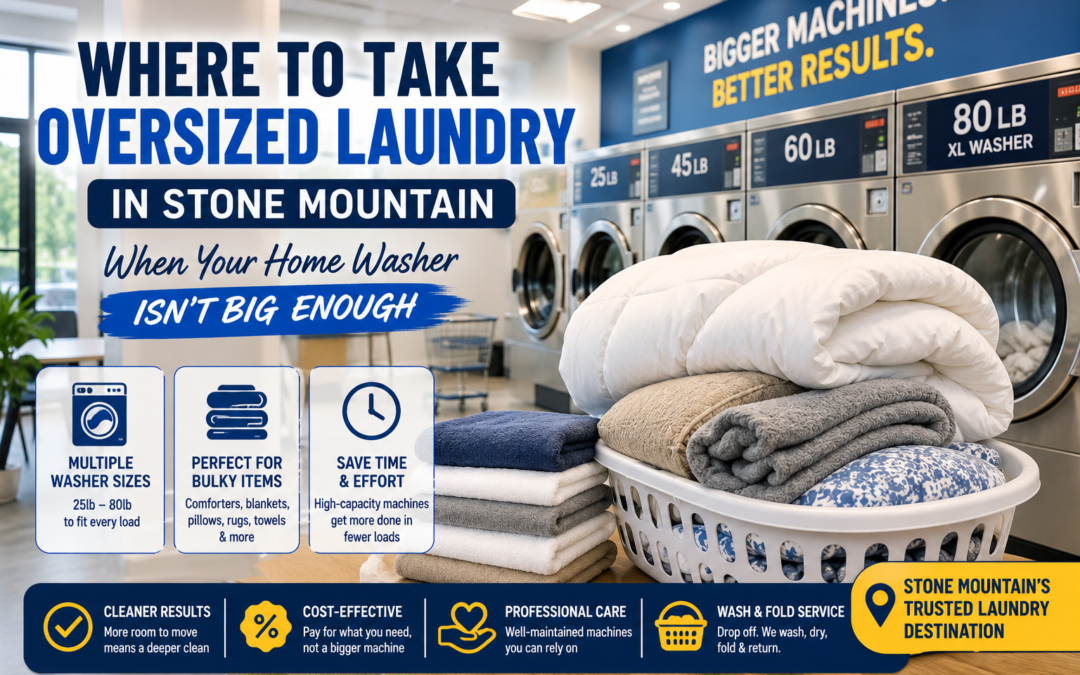
At Smiley Laundromat in Stone Mountain, customers can choose from several washer capacities, including 25-pound, 45-pound, 60-pound, and 80-pound machines. The largest XL washer is designed for particularly bulky items such as comforters, bed sets, pillows, and rugs.
But there is more to oversized laundry than simply finding the largest machine.
The real question is:
How much space does your laundry need to be washed effectively, and which laundry solution makes the most sense for your particular situation?
That is what this guide explores.
What Counts as Oversized Laundry?
When people hear the phrase “oversized laundry,” they often think about king-size comforters.
Those are certainly part of the category, but oversized laundry is much broader.
It can include:
-
King and queen comforters
-
Heavy blankets
-
Quilts
-
Bedspreads
-
Mattress pads
-
Large bedding sets
-
Pillows
-
Curtains
-
Washable rugs
-
Large quantities of towels
-
Multiple sets of sheets
-
Large family laundry loads
-
Seasonal bedding
-
Bulky household textiles
The interesting thing is that an item does not necessarily have to be extremely heavy to be oversized.
Volume matters just as much as weight.
A lightweight comforter can take up far more space than several pounds of T-shirts.
A thick fleece blanket can occupy an enormous amount of washer space even though it does not weigh as much as a comparable quantity of wet towels.
This distinction is one of the most important things to understand before putting bulky laundry into a residential washer.
Why “If It Fits, It Washes” Is a Bad Laundry Strategy
One of the easiest mistakes to make is assuming that if an item physically fits inside the washing machine, the machine is large enough.
Imagine stuffing a sleeping bag into a backpack.
You may technically get it inside.
But that doesn’t mean the backpack has enough room for the sleeping bag to move.
A washing machine has a similar requirement.
Laundry needs room to move through the wash cycle.
Water needs to circulate.
Detergent needs to reach the textile surfaces.
Mechanical action needs to work against the fabric.
During rinsing, water needs to move through the load and remove detergent and suspended soil.
If a bulky item fills virtually every available inch of the drum, all of those processes can become more difficult.
This is why the question shouldn’t be:
“Can I close the washer door?”
It should be:
“Does this load have enough room to move properly?”
That is a much more useful way to evaluate washer capacity.
The Science Behind Washer Capacity
There are two basic characteristics you need to consider when thinking about laundry capacity:
Weight and volume.
They are related, but they are not interchangeable.
Imagine two laundry loads that each weigh 10 pounds.
The first consists primarily of lightweight shirts and athletic clothing.
The second consists of thick cotton towels.
The two loads may weigh the same, but the towels will behave very differently inside the washer because they occupy different amounts of space and absorb significant quantities of water.
Now consider a large comforter.
It may be surprisingly lightweight when dry.
But it can occupy most of a residential washer’s drum.
Once saturated, it becomes much heavier.
This is why oversized laundry should not be judged by weight alone.
A properly sized washer provides enough usable space for the laundry to move during the wash process.
That movement is part of the cleaning process.
Why Bulky Items Become Even More Challenging When Wet
Dry fabric and wet fabric behave very differently.
A comforter that feels relatively manageable when you pick it up from the bed can become substantially heavier once it absorbs water.
The same is true for:
-
Blankets
-
Towels
-
Quilts
-
Mattress pads
-
Heavy bedding
That means a washer that was already crowded before the cycle began now has to deal with a much heavier, water-saturated load.
The fabric needs to move.
Water needs to move through it.
The machine needs to extract water during the spin phase.
Then the dryer needs to remove the remaining moisture.
This is why adequate capacity matters throughout the entire laundry process—not just when you’re loading the washer.
Where to Take Oversized Laundry in Stone Mountain
For Stone Mountain residents whose home washing machine isn’t large enough, a laundromat with multiple commercial-size machines can be a practical solution.
Smiley Laundromat offers several washer capacities so customers can choose equipment according to the size and characteristics of their laundry.
The available capacities include:
25-pound washers for smaller everyday loads.
45-pound washers for medium-size laundry quantities.
60-pound washers for larger household loads and bulkier items.
80-pound XL washers for very large loads and oversized laundry such as comforters, bed sets, pillows, and rugs.
This range is important because not every laundry problem requires the same solution.
A small basket of clothing doesn’t need an 80-pound machine.
A king-size comforter may need considerably more room than a typical household load.
The goal is to match the machine to the laundry.
Why Multiple Washer Sizes Matter
Imagine going to a laundromat that has only one washer size.
You either use a machine that is too small or a machine that is unnecessarily large.
Neither situation is ideal.
A facility with multiple capacities gives customers more control.
For example, you might use a smaller machine for:
-
Shirts
-
Jeans
-
Socks
-
Undergarments
-
Lightweight clothing
A medium machine could be useful for:
-
Towels
-
Multiple clothing loads
-
Baby bedding
-
Sheets
-
Smaller blankets
A larger machine may make more sense for:
-
Large quantities of clothing
-
Bedding
-
Curtains
-
Multiple blankets
-
Larger towel loads
An XL machine can be particularly useful for:
-
Comforters
-
Large bed sets
-
Pillows
-
Rugs
-
Very bulky laundry
This is much more practical than forcing every laundry situation into the capacity of a single residential washer.
How to Choose the Right Laundromat Washer for a Comforter
There is no universal rule that says every comforter requires exactly one particular washer size.
Why?
Because comforters are different.
A thin summer comforter is not the same as a thick winter comforter.
A lightweight synthetic comforter behaves differently from a dense quilt.
A twin comforter is obviously different from a king-size comforter.
So instead of thinking only about the bed size, consider:
Thickness
How thick is the comforter?
Construction
Is it down, down alternative, cotton, polyester, or another material?
Overall Volume
How much space does it occupy when loosely placed in the washer?
Manufacturer Instructions
Does the care label permit machine washing?
Available Movement
Will the item have enough room to move through the wash cycle?
These questions are more useful than simply asking whether the comforter can physically fit.
King-Size Comforters: The Classic Home Washer Problem
King-size comforters are among the most common reasons customers seek a large-capacity laundromat in Stone Mountain.
They are simply large.
Even before washing, a king-size comforter can take up a significant portion of a residential washer.
Once water is introduced, the situation becomes even more challenging.
Trying to wash one in an undersized machine can create several practical problems:
-
Restricted movement
-
Poor water circulation
-
Uneven saturation
-
Inadequate rinsing
-
Difficult extraction
-
Longer drying
-
Uneven drying
A properly sized commercial washer provides more usable space.
The goal isn’t to make the comforter fit.
The goal is to give the comforter enough room to move.
What About Queen-Size Comforters?
Queen-size bedding can present similar issues.
Some lightweight queen comforters may fit appropriately in larger residential machines.
Others may be too bulky.
The key is not the label “queen.”
The key is the actual construction and volume of the item.
If your home washer looks completely filled when you place the comforter inside, consider using a larger-capacity washer rather than trying to compress it into the drum.
This can be especially useful when you have other bedding to wash at the same time.
Blankets Can Be More Complicated Than They Look
Blankets seem simple.
But thickness makes an enormous difference.
A thin throw blanket may be easy to wash.
A heavy fleece blanket is another matter.
A large winter blanket can consume a significant amount of drum space.
Multiple blankets can quickly become a capacity problem.
This is where a laundromat becomes particularly useful.
Instead of dividing everything into several small household loads, you can select a larger machine based on the amount of laundry you actually need to process.
That can save time while giving the textiles more space to move.
Washing Bedding Without Turning It Into an All-Day Project
Bedding is another reason laundry can quickly become overwhelming.
Think about everything that might need to be washed during a normal bedding change:
-
Fitted sheets
-
Flat sheets
-
Pillowcases
-
Mattress protectors
-
Comforters
-
Blankets
-
Pillow covers
For a large household, that can represent several separate loads.
A residential washer may be able to handle each item individually.
But the question becomes:
How long do you want to spend doing it?
The laundry process includes much more than the wash cycle.
You have to:
-
Strip the beds
-
Sort the bedding
-
Load the washer
-
Transfer the load
-
Start the dryer
-
Check the drying process
-
Remove the laundry
-
Fold everything
-
Carry it back
-
Reassemble the beds
A larger laundromat machine can increase the amount you process in a single cycle.
A professional wash and fold service can eliminate much of the labor altogether.
The Difference Between a Capacity Problem and a Time Problem
This is one of the most useful ways to think about laundry.
Sometimes the problem is:
“My washer isn’t big enough.”
That’s a capacity problem.
The solution may be a large-capacity laundromat washer.
Other times the problem is:
“I don’t have time to do this.”
That’s a labor problem.
The solution may be a wash and fold laundry service.
And sometimes the problem is:
“I don’t have time to wash it, fold it, or even make a trip to the laundromat.”
That’s where pickup and delivery can become valuable.
The right service depends on the actual problem.
When Self-Service Laundry Makes the Most Sense
Self-service laundry is ideal when you want control over the process but need better equipment than you have at home.
It can be especially useful when:
-
Your washer is too small
-
Your dryer is too small
-
Your appliances are being repaired
-
You have several loads to process
-
You have bulky bedding
-
You need to wash a large quantity of towels
-
You are preparing seasonal bedding
-
You want to complete laundry in fewer cycles
You still manage the laundry yourself.
But you get access to equipment designed for larger loads.
For many customers, that is the perfect middle ground between home laundry and full-service laundry.
When Wash and Fold Is the Better Option
Now imagine that you have five loads waiting.
Your home washer is too small.
You could drive to the laundromat.
You could sort everything.
You could load the machines.
You could transfer everything to dryers.
You could wait.
You could fold everything.
Technically, you can do it.
But should you?
That’s where wash and fold laundry service in Stone Mountain can make sense.
Instead of paying primarily for machine access, you’re paying for someone else to manage the repetitive work.
Smiley Laundromat’s wash and fold service is designed for customers who want their laundry washed, dried, folded, and packaged.
Customers can also communicate special preferences, and identified stains can receive pre-treatment.
The value isn’t simply cleaner laundry.
It’s the removal of a time-consuming household responsibility.
The Convenience Equation
Laundry service becomes particularly attractive when your schedule is already full.
Consider a parent with:
-
Work responsibilities
-
School schedules
-
Children’s activities
-
Grocery shopping
-
Cooking
-
Household cleaning
-
Errands
Adding four or five hours of laundry management to that schedule is not insignificant.
The same is true for professionals who work long hours.
Or seniors who don’t want to carry heavy laundry baskets.
Or families dealing with an unusually large laundry backlog.
Or people preparing for a move.
Or anyone returning from a long trip with multiple bags of dirty clothing.
The practical benefit of wash and fold is that it converts laundry from a time requirement into a service.
For more detail on the speed and convenience side of professional laundry, you can naturally link to Why Smiley Laundry’s Wash & Fold Service Stands Out for Speed and Convenience.
What Makes Large-Capacity Laundry More Efficient?
Efficiency isn’t necessarily about washing the largest possible amount of laundry in one machine.
It’s about reducing unnecessary steps while maintaining appropriate laundry care.
A large-capacity washer can potentially reduce the number of cycles required for compatible loads.
That can mean:
-
Fewer loading steps
-
Fewer unloading steps
-
Fewer transfers
-
Fewer drying cycles
-
Less waiting
-
Less folding
But there is an important qualification:
Don’t combine incompatible laundry simply because you have a large washer.
Color, fabric, soil level, temperature requirements, and care instructions still matter.
Large capacity gives you flexibility.
It doesn’t eliminate the need for good laundry practices.
Oversized Laundry Requires the Right Dryer, Too
Many people focus entirely on the washer.
But a comforter that is washed correctly can still become a problem if the dryer is too small.
A dryer needs adequate space for the item to tumble.
The movement exposes different portions of the fabric to warm air.
If the comforter is compressed into a small dryer, the process may take longer and moisture can remain trapped in thicker areas.
This is why oversized laundry should be considered as a complete process:
Wash → Extract → Dry → Check → Finish
Not simply:
Wash → Done
The right dryer capacity can be just as important as the right washer capacity.
Why More Heat Is Not Always Better
If a comforter takes too long to dry, the instinct may be to increase the temperature.
That isn’t always appropriate.
Different materials have different heat tolerances.
Some fabrics can shrink.
Some synthetic materials can be damaged by excessive heat.
Some filled bedding requires specific drying instructions.
Always follow the manufacturer’s care label.
The best approach is appropriate:
-
Temperature
-
Drying time
-
Tumble action
-
Load capacity
Good laundry care is about controlling the process, not maximizing heat.
How to Wash Towels When You Have Too Many
Towels create a special capacity challenge because they are highly absorbent.
A few towels aren’t usually a problem.
A household with dozens of towels is different.
A business such as a salon, spa, fitness studio, or other service provider can have even more.
When towels become saturated, their weight increases dramatically.
They also require enough space to move and rinse effectively.
A larger-capacity washer can make processing large towel loads much more practical.
For businesses, however, the issue often extends beyond capacity.
It’s staff time.
That’s where commercial wash and fold becomes an important option.
Commercial Laundry: When Oversized Loads Become a Business Problem
Imagine running a spa.
Your staff has to wash towels every day.
Or a salon with baskets of towels constantly accumulating.
Or a fitness studio where clean towels are part of the customer experience.
Or a restaurant that handles washable linens.
Or a short-term rental property that needs sheets and towels ready between guests.
At that point, laundry isn’t just a household chore.
It’s an operational process.
The question becomes:
How much staff time should be devoted to laundry?
Commercial laundry service can move that responsibility outside the core business operation.
Smiley Laundromat offers commercial laundry solutions for businesses such as restaurants, salons, barbershops, spas, fitness studios, and short-term rental operators.
For these customers, professional laundry is less about convenience in the traditional sense.
It is about operational efficiency.
Airbnb Hosts Have a Unique Laundry Problem
Short-term rental operators understand the importance of turnaround time.
A guest checks out.
Another guest may arrive the same day.
The property needs to be:
-
Cleaned
-
Inspected
-
Restocked
-
Prepared
-
Ready
And somewhere in that process is a large amount of laundry.
Sheets.
Pillowcases.
Bath towels.
Hand towels.
Washcloths.
Kitchen towels.
Blankets.
The laundry needs to be processed quickly and consistently.
For a host managing multiple properties, washing everything personally can quickly become an operational bottleneck.
Professional laundry service can help move that bottleneck out of the property-management workflow.
Seasonal Laundry Is Another Perfect Use Case
Think about what happens when winter ends.
You suddenly have:
-
Heavy comforters
-
Thick blankets
-
Seasonal bedding
-
Winter textiles
that need to be cleaned before storage.
Then the process reverses when colder weather arrives.
This is where large-capacity laundry can save a significant amount of time.
Instead of running multiple household cycles, you can process appropriate items using larger machines.
If you don’t want to manage the process yourself, wash and fold can take over the work.
The same principle applies to spring cleaning, moving, guest preparation, and other times when laundry volume temporarily increases.
What About Curtains?
Curtains are often overlooked when people think about oversized laundry.
A single curtain panel may not weigh much.
But it can be extremely large when gathered together.
Multiple panels can quickly occupy a residential washer.
Before washing curtains, check the care instructions carefully.
Look for:
-
Machine-washing instructions
-
Fabric composition
-
Shrinkage warnings
-
Lining requirements
-
Special drying instructions
-
Decorative elements
If machine washing is permitted, a larger laundromat washer can provide more room than many residential machines.
What About Washable Rugs?
Rugs require extra caution.
Not every rug belongs in a washing machine.
Before bringing a rug to a laundromat, determine:
-
Whether it is machine washable
-
Whether the backing can tolerate washing
-
Whether the colors are stable
-
Whether the manufacturer permits machine drying
-
Whether adhesives or decorative elements are present
If the care instructions allow machine washing, a large-capacity washer may be useful for bulky rugs.
Smiley Laundromat’s XL machine is designed to accommodate rugs among other oversized laundry items.
But remember:
A large washer solves a size problem. It does not override a manufacturer’s care instructions.
What Should You Do Before Bringing Oversized Laundry to a Laundromat?
A few minutes of preparation can make a major difference.
Read the Care Label
This should always come first.
Empty Every Pocket
Small objects can damage clothing and potentially interfere with equipment.
Check Seams and Zippers
Oversized items are subject to substantial movement during washing.
Repair obvious damage before laundering.
Separate Laundry Properly
Do not mix everything simply because the washer is large.
Identify Stains
If you’re using wash and fold, point out stains that require additional attention.
Remove Hardware
Curtain hooks, detachable accessories, and similar components may need to be removed.
Estimate Your Load
Choose the machine according to the actual volume and bulk of the laundry.
Don’t Automatically Choose the Biggest Washer
This deserves emphasis.
If you have one small load, using the largest machine may be unnecessary.
If you have several loads of ordinary clothing, a medium or large machine may be more appropriate.
If you have a thick king-size comforter, an XL machine may make more sense.
The goal is not to select the biggest machine.
The goal is to select the right capacity.
That is one reason a laundromat with multiple machine sizes is more useful than a facility built around a single machine type.
The Cost of Buying a Bigger Washer vs. Using a Laundromat
Suppose your current washer isn’t large enough.
Your first instinct might be to purchase a larger appliance.
Before doing that, consider how frequently you actually need the additional capacity.
A new washer can involve:
-
Purchase cost
-
Delivery
-
Installation
-
Plumbing
-
Electrical requirements
-
Space
-
Maintenance
-
Repairs
-
Replacement
If you only need XL capacity a few times a year, purchasing specialized equipment may not be the most practical approach.
A laundromat allows you to access large-capacity equipment when you actually need it.
This is one of the basic advantages of shared infrastructure.
You pay for access rather than carrying the full ownership burden.
What If You Need Oversized Laundry Every Week?
That’s different.
If you consistently have more laundry than your home washer can handle, you should look at the problem as a recurring workflow.
Ask:
How many loads are we generating?
How much time does laundry consume?
How frequently do we wash bulky items?
How much folding is involved?
Would a larger machine reduce the workload?
Would professional wash and fold save even more time?
You may discover that the best answer is not simply using a laundromat occasionally.
It may be establishing a regular laundry routine that combines self-service and professional service.
A Hybrid Laundry Strategy Can Be the Most Practical
You don’t have to choose one laundry method forever.
A household can use different options for different situations.
For example:
Everyday clothing: Home washer.
Large family laundry day: Large-capacity laundromat.
Comforters: XL laundromat washer.
Seasonal blankets: Large-capacity machines.
Busy workweek: Wash and fold.
Major laundry backlog: Professional laundry service.
Business laundry: Commercial wash and fold.
This is often more practical than trying to make one system handle every situation.
How Smiley Laundromat Fits Into the Picture
Smiley Laundromat is designed to accommodate different types of laundry rather than assuming every customer has the same needs.
If you want to handle your own laundry, self-service machines provide multiple capacities.
If you want someone else to handle the work, wash and fold is available.
If convenience extends beyond the facility, pickup and delivery services provide another option.
For oversized laundry specifically, the range of washer capacities is important.
The 80-pound XL machine provides a solution for bulky items that would be difficult to process in many residential washers.
The 60-pound machine gives customers another option for larger quantities and moderately bulky items.
The 45-pound machine provides additional flexibility for medium-sized loads.
And smaller machines are available for everyday laundry.
That gives customers something important:
choice.
What Makes Professional Laundry Service Different?
There is a psychological difference between owning a washer and having access to a laundry provider.
When you own a washer, laundry is your responsibility.
You have to:
-
Plan it
-
Sort it
-
Wash it
-
Dry it
-
Fold it
-
Put it away
When you use self-service laundry, you still do most of those things—but you gain access to equipment designed for larger loads.
When you use wash and fold, the equation changes.
The provider takes over the processing.
That means the value isn’t just machine capacity.
It’s time capacity.
You are effectively creating more room in your schedule.
For a deeper look at this idea, Why Smiley Laundry’s Wash & Fold Service Stands Out for Speed and Convenience is a natural internal resource to reference here.
How Turnaround Time Changes the Value of Laundry Service
Professional laundry isn’t useful simply because someone else does the work.
It also needs to fit into your schedule.
Predictable turnaround matters.
If you know when your laundry will be ready, you can plan around it.
This becomes especially important for:
-
Busy households
-
Professionals
-
Families
-
Airbnb hosts
-
Small businesses
-
Recurring commercial laundry
Smiley Laundromat offers a 48-hour wash and fold turnaround, providing customers with a defined timeframe for getting their processed laundry back.
For customers who want to understand how predictable turnaround can help prevent laundry from accumulating, How Smiley Laundry’s 48-Hour Wash & Fold Service Helps Customers Stay Ahead is a useful internal article to explore next.
Oversized Laundry Doesn’t Have to Become a Weekend Project
This is perhaps the biggest practical lesson.
A comforter is one item.
But if your home washer cannot handle it properly, that one item can turn into:
-
Multiple wash cycles
-
Multiple drying cycles
-
Repeated transfers
-
Extra waiting
-
More folding
-
More handling
A large-capacity laundromat can reduce that complexity.
Professional wash and fold can reduce it even further.
And that is why the best laundry solution isn’t necessarily the one that costs the least per individual machine cycle.
It’s the one that solves the entire problem efficiently.
A Simple Decision Guide for Stone Mountain Residents
Before your next oversized laundry trip, ask yourself these questions.
Is the item machine washable?
If not, stop there and follow the manufacturer’s recommended cleaning method.
Is the item bulky?
If it occupies most of your washer, consider larger equipment.
Does your home washer allow sufficient movement?
If the answer is no, don’t force it.
Do you have several oversized items?
Consider using a laundromat with multiple capacities.
Do you have time to manage the laundry?
If yes, self-service may be ideal.
Do you want the laundry handled for you?
Consider wash and fold.
Do you want to minimize the trip as well?
Consider pickup and delivery where appropriate.
Is this a recurring problem?
If so, create a regular laundry strategy instead of solving the same problem from scratch every time.
Frequently Asked Questions
Where can I wash an oversized comforter in Stone Mountain?
A laundromat with large-capacity commercial washers can be a practical option for machine-washable oversized comforters. Smiley Laundromat offers an 80-pound XL washer designed for bulky laundry, including comforters and bed sets.
What is the best washer size for a king-size comforter?
The appropriate size depends on the comforter’s thickness, construction, and care instructions. A large or XL-capacity washer can provide more usable space than a typical residential machine.
Can I wash blankets at a laundromat?
Yes, if the care label permits machine washing. Large-capacity washers can be particularly useful for thick or oversized blankets.
Can I wash pillows in a laundromat?
Some pillows can be machine washed, while others require specialized care. Always follow the manufacturer’s instructions. Smiley Laundromat’s XL washer is designed to accommodate pillows among other bulky items.
Can I wash a rug at a laundromat?
Some rugs are machine washable, but not all. Check the manufacturer’s care instructions before washing. If machine washing is approved, a large-capacity washer may be appropriate for bulky rugs.
Is a laundromat useful if I already own a washing machine?
Absolutely. Homeowners may use laundromats when they need larger capacity for comforters, blankets, rugs, towels, seasonal bedding, or unusually large laundry loads.
Should I use self-service or wash and fold?
Choose self-service when you want to control the laundry process yourself. Choose wash and fold when saving time and eliminating the work is more important than doing the laundry personally.
How do I know if my home washer is too small?
If a bulky item fills the drum so completely that it cannot move freely, the washer may not provide adequate usable capacity for that item. Physical fit alone isn’t a sufficient test.
When Your Laundry Outgrows Your Washer, Change the Equipment—not the Laundry
A home washing machine is incredibly useful.
But it has limits.
It was designed around a particular capacity.
And eventually, almost every household encounters laundry that exceeds those limits.
It might be a king-size comforter.
It might be several thick blankets.
It might be a stack of towels.
It might be seasonal bedding.
It might simply be a week’s worth of laundry that accumulated while life got busy.
When that happens, you don’t have to force everything into a residential machine.
You have another option.
A laundromat gives you access to equipment with significantly greater capacity.
Smiley Laundromat in Stone Mountain offers 25-pound, 45-pound, 60-pound, and 80-pound washer options, allowing customers to select a machine according to the size and characteristics of their laundry.
For particularly bulky items such as comforters, bed sets, pillows, and rugs, the 80-pound XL washer provides the additional space that many residential machines simply cannot offer.
And when the problem is not just capacity but time, wash and fold service can take the entire laundry process off your hands.
That’s the real advantage of having a professional laundry provider nearby.
You don’t have to buy a commercial washer because you occasionally need commercial capacity.
You don’t have to spend an entire Saturday processing an oversized laundry backlog.
You don’t have to compromise by squeezing a bulky comforter into a machine that isn’t designed for it.
Instead, you can choose the solution that fits the job.
Use your home washer for everyday laundry when it works well.
Use a large-capacity laundromat when your laundry outgrows your equipment.
Use wash and fold when your laundry outgrows your schedule.
And when you need even greater convenience, consider a laundry pickup and delivery option.
Because the smartest approach to laundry isn’t trying to make one machine do everything.
It’s knowing when the job requires more capacity—and knowing where to find it.
For Stone Mountain residents searching for large-capacity washers, oversized laundry service, comforter laundry service, wash and fold laundry service, or a convenient laundromat for bulky bedding, Smiley Laundromat provides a practical solution designed around the reality of modern laundry.
Your comforter doesn’t need to fit into your life around the limitations of your washing machine.
Your laundry solution should fit the laundry you actually have.
Recent Comments